
Minimum Wage Increase, Economic Issues Are News Gathering Topics In JRN 336
By John McNamara
Journalism students in the newswriting & reporting II class at Central Connecticut State University are on the government and public policy beat in the Spring semester of 2024. They are gathering information, interviewing local officials, attending a New Britain Common Council meeting and writing about issues such as neighborhood blight, education and the impact of a higher Connecticut minimum wage on the city and its residents.
In our capacity as local elected officials Common Council President Francisco “Cisco” Santiago (D-5) and I attended Assistant Professor Kate Farrish’s February 5th morning class, fielding questions in a news conference format that mainly focused on the minimum wage increase to $15.69 per hour. The class also heard from Council Minority Leader Robert Smedley (R-4) and Alderman Alden Russell (R-1) who responded to the same questions.
The questions from the Journalism majors did not disappoint in a course that “emphasizes news-gathering procedures and the challenges of writing on government, the law, and other areas of journalistic specialization.” Time ran out quickly during the 70-minute class before all 13 student journalists’ questions on wages, education, city finances, homelessness and housing could be answered.
On the minimum wage the questions were even handed, taking into account all sides of the debate.
- “How do you balance the interests of local businesses with the need to ensure fair wages for workers?” Kyle Zarnoch
- “Do you think the minimum wage increase makes living in New Britain more affordable?” Yvonna Rodriguez
- “What is the reason for the economic disparity in New Britain? What are city leaders doing to level it out?” Aniya Pouncey
- “How do you perceive the relationship between the minimum wage increase and the cost of living in New Britain?” Nathalia Blair
Cisco and I noted that a hike in the minimum wage can help many New Britain residents facing higher prices for basic necessities and post-pandemic rent increases. New Britain’s median household income is $50,379 compared to the state’s $83,572. Sixty percent of residents are tenants. While city government does not have a say on state wage laws directly it can respond with economic relief through the fair rent commission to curb gouging by absentee landlords. It delivers within the limits of grants and the municipal budget community services to individuals and families on fixed or limited incomes. The city also has a “living wage” ordinance on the books that can require contractors and vendors doing business with the city to pay their workers a higher wage tied to the cost of living. City government also has the power to insist on prevailing wages that ensure union pay and benefits for public projects.
I pointed out that the jump to $15.69 an hour still falls far below the living wage for Hartford County based on the typical expenses for households in the region. According to MIT’s living wage calculator covering states and counties in the U.S., an individual with no children should be earning $22.66 per hour in Hartford County. A couple with two children typically need $43.94 each to be making a living wage.
The state minimum wage that took effect January 1 is especially significant for students to be covering now. Connecticut and other states have gradually adopted higher minimums in piece meal-fashion over the last 20 years. The federal minimum of $7.25 stays ridiculously frozen amid Washington gridlock and a powerful anti-labor lobby. This year Connecticut’s law finally ties the minimum to a cost-of-living formula that will allow it to increase as the prices of goods and services increase.
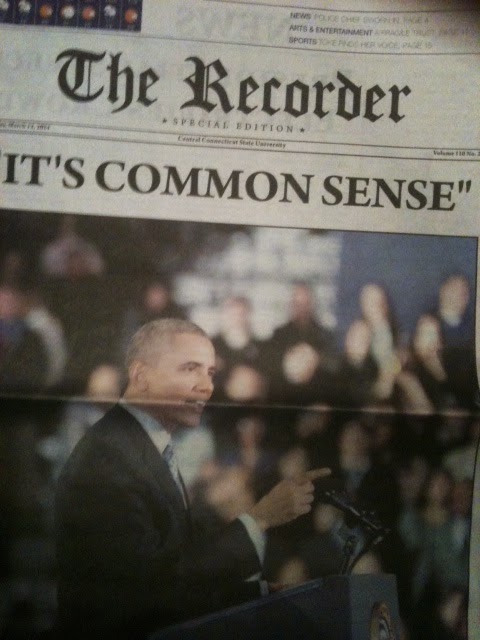
Our February 5th “news conference” with the students at DiLoreto Hall reminded me that Assistant Professor Farrish’s students were in grade school 10 years ago when President Barack Obama visited the CCSU campus. (video). Joined by New England Governors, Obama attended a “Fight for $15” rally for a federal increase that has never come. As Obama made his case for federal action a student yelled out from the Kaiser Hall’s Detrick gymnasium stands “it’s common sense” whereupon Obama adopted that as his refrain and it made for a good headline in The Recorder, CCSU’s student newspaper that year. (See photo).


Left photo: The front page of The Recorder, CCSU’s student newspaper, with coverage of the Presidential rally for a higher minimum wage at Kaiser Gymnasium in March 2014. Right Photo: Hartford Courant photo of Barack Obama at CCSU greeting the late Emma Pierce, Democratic State Central Committeewoman of New Britain and New Britain DTC Chair John McNamara.
I left the CCSU journalism class greatly encouraged by the hard questions posed by students and their interest in journalism amid challenging times for both local news coverage and sustainable employment of those who provide it. The newswriting class taught by Assistant Professor Farrish, a seasoned editor and reporter from her Hartford Courant days, emphasizes the basics about reporting the news, a skill very much needed in a media landscape that is too heavy on misinformation and light on what the public needs to know. It was not unlike my newswriting classes 50 years ago at Boston University’s College of Communication (formerly the School of Public Communication) that led to an eventful stint at BU’s Daily Free Press and after graduation, convincing the editor of the Lynn (MA) Sunday Post into hiring me as the City Hall and State House reporter for a couple of years. Those early reporting experiences as a commuter student and the first member of my family to get to college have served me well wherever life has taken me.
(John McNamara is a Ward 4 Alderman and Majority Leader of the New Britain Common Council)
 NB Politicus