

Citizen Action Group Recognizes Third Act Leader; Celebrates 20 Years of Citizen Elections Program
By John McNamara
The Connecticut Citizen Action Group honored the Rev. Dr. Davida Foy Crabtree on December 4 at its awards and campaign finance reform anniversary celebration in West Hartford.
Rev. Dr. Crabtree, a United Church of Christ (UCC) minister, received the Laddie Michalowski Community & Labor Award that recognizes “building bridges between worker and community organizations” and is named for Laddie Michalowski, a key leader in New Britain’s labor movement and organizer for peace and civil rights who was a longtime member of CCAG’s Board of Directors.
Rev. Dr. Crabtree, a former spiritual leader of UCC’s Connecticut Conference, is a founder of Connecticut’s Third Act, “the statewide movement focused on climate and democracy.”
In recognizing Rev. Crabtree, CCAG cited her leadership in “building a statewide network of elders” that is challenging the fossil fuel industry and advancing renewable energy in addition to her lifetime of work on women’s and labor rights. The Third Act organization, launched nationally by Environmentalist Bill McKibbon, engages members who are 60 years old and older in advocacy and social action.
Organizing Third Act Connecticut continues Rev. Crabtree’s decades of activism in her church and in the community that goes back to the early 1970s when she was a newly ordained minister in New Britain.

Rev. Crabtree was a campus minister at Central Connecticut State University (CCSU), and helped to organize an “emergency lifeline for victims of domestic violence” in the basement of South Congregational Church. The project became the forerunner of the Prudence Crandall Center that has been recognized as one of the first agencies of its kind. Today the Crandall Center “serves more than 10,000 adults and children with a full spectrum of shelter, housing, prevention and support services.”
Amy McLean Sals, Chairperson of the Simsbury Democratic Town Committee and a CCRG board member, presented the award to Rev. Crabtree, McLean Sals first met Rev. Crabtree as a child growing up in New Britain. Her late father, the Rev. Alan McLean, was among a group of New Britain progressives who worked with Laddie Michalowski on civil rights and social issues.
“This award is among the most meaningful I could possibly receive,” Rev. Crabtree told more than 200 CCAG supporters. “I remember meeting Laddie when I was in New Britain. I was powerfully moved by his social witness, by the stance that he took. When you receive an award in the name of someone you have known –wow!”
Rev. Crabtree shared the mission of Third Act that involves collaborations with CCAG and other groups:
“I have found in Third Act a community of people who care for one another and who want to convert their experiences into power for change. That is its essence and our twin issues are really one issue, climate and democracy . There are no oligarchs who care one whit about the planet. Democracy and climate go hand in hand. If our democracy slate is being wiped clean, we can build in the future a new democracy that is not just a political democracy but an economic democracy;”
Receiving CCAG’s Nancy Benedict Social Justice Award were Effie and Angaza Mwando for their work in Torrington and Northwest Connecticut as co-founders of “Our Culture Is Beautiful“, a project that bridges gaps and promotes diversity in the community through arts and cultural activities. In “retirement” the Mwandos continue their social justice efforts by partnering with schools, leading public drum circles and organizing living-history programs
Celebrating Twenty Years Of Clean Elections
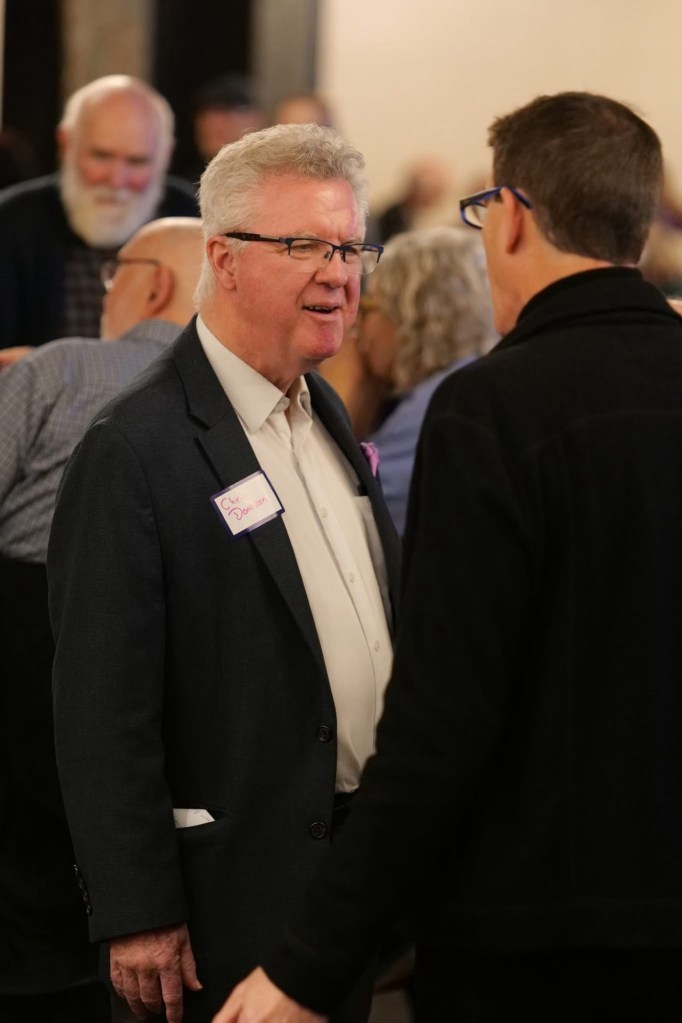
Former CT House Speaker Chris Donovan (D-Meriden) and other legislative allies of the citizen action group attended the awards night to celebrate 20 years of the Citizens Election Program (CEP).
CCAG Executive Director Tom Swan called CEP “a gold standard for campaign finance reform throughout the country. Our system allows ordinary people to garner support and resources to run for office without being beholden to lobbyists and corporations.”
The CEP became law in 2005 as part of “sweeping campaign finance” legislation in the aftermath of Governor John Rowland’s resignation over corruption and scandals in his administration. Gov. Jodi Rell, Rowland’s Republican successor, signed the legislation and the law was implemented in 2008.
CCAG helped elect and supported legislators who “designed, debated and passed” campaign finance reform, according to Swan. One of them was Donovan, formerly a community and labor organizer, who was first elected a state representative in 1992 and rose to serve as Speaker of the House in 2009. Donovan, as Majority Leader from 2004 to 2008, played a key role in the CEP’s passage. Swan and Donovan described the debate over reform to end the undue influence of corporate and lobbyist money in politics as a “sustained and multi-faceted organizing campaign.”
Passage required many incumbents, accustomed to funding campaigns from corporate political action committees and lobbyists’ support, “to vote against their self interests and give their opponents equal public funding.” An initial proposal, according to Donovan, called for a first phase of public financing for statewide candidates only (governor and constitutional offices) but negotiations with Governor Rell led to the more comprehensive bill to include the legislature that is a model for state public finance systems.
The voluntary CEP program involves candidates raising “seed money” from constituents in their districts in amounts ranging from $5 to $250. Qualifying contributions trigger a public grant that is primarily funded by the state’s sales of abandoned property. Over the last decade more than 80% of candidates have turned to CEP for their campaigns excluding special interest money.
Organizers of the CCAG awards program noted that CEP “has enabled more women and people of color to seek office and has built a more representative legislature rooted in the community. CEP’s public financing makes campaigns viable for candidates without deep pockets or corporate interest backing, helping lawmakers tackle issues long stalled by special-interest pressure.”
CCAG, founded in 1970 by Consumer Advocate Ralph Nader and led by former Congressman Toby Moffett in its early years, is considered Connecticut’s oldest and largest public interest group. It is a membership-based organization that has played a prominent role in campaigns for clean elections,, consumer protection, universal healthcare and environment protection.
John McNamara is a Ward 4 Alderman and Majority Leader of the New Britain Common Council.
 NB Politicus