

Remaining Pandemic Relief Funds Are An Option For Long Delayed Drainage Improvements
By John McNamara
Heavy rains have overwhelmed two New Britain neighborhoods this summer causing basement and street flooding on streets in the Allen Street and Overlook Avenue areas.
The recent storms are raising new concerns and outrage from residents who have been asking for repairs to the aging sewer and pipe system for many years.
NB Politicus
On streets adjacent to Allen Street near Central Connecticut State University (CCSU), century-old pipes and backed-up catch basins cannot keep up with even one or two inches of storm water, according to residents, who saw more flooding on Saturday, September 9th, the fourth storm this summer to turn streets into rivers and make dozens of homes vulnerable to flooding.
July’s heavy rains also caused extensive flooding to Overlook Avenue, another neighborhood vulnerable to storm water overflows, that drew extensive media coverage. City officials responded to the news coverage and complaints by promising that $2 million in uncommitted federal America Rescue Plan Act funds will go to upgrade the drainage system on Overlook Avenue. Residents in the Allen Street area are also seeking immediate action to reduce the flood risk after nearly 30 years of seeking help from the city.
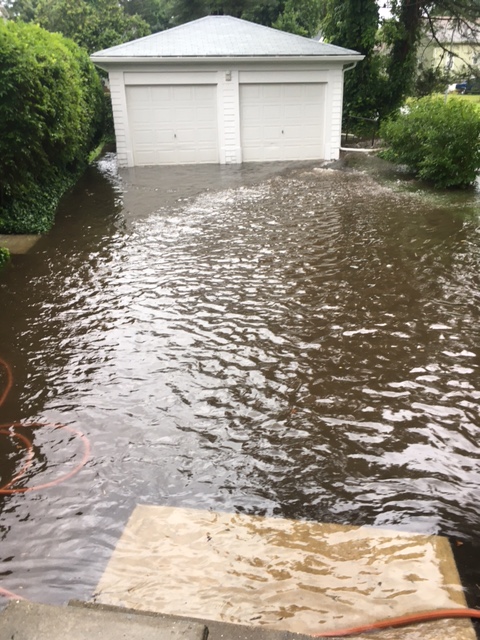
(photo courtesy of Frank Chase)
The problems near Allen Street (including Eton Place, Roxbury Road, Newbury, Hampton and Brighton streets) and Overlook Avenue are not new. Capital Improvements recommended and adopted by the Common Council over the last five years, pinpointed both Allen Street and Overlook Avenue as sites for “upgrading the storm drainage system” and the “replacement of undersized and deteriorated storm and sanitary sewer mains.”
Improving the sewer and storm water system at two of its weakest points, however, has not been given a high priority. While other infrastructure projects have gotten attention and money in recent years, officials have told residents that they are waiting for the allocations to implement their sewer upgrades. In fiscal year 2020, for example, reconstruction of Allen Street was slated for action in 2022 at a cost of $5 million to be paid by a combination of state, federal or local funds. Every year since, however, the planned improvements have been pushed into the future. In the Capital Improvement Program (CIP) adopted with the municipal budget in June, the Allen Street project was put off again to 2027-2028 at an estimated cost of $6.7 million. The Overlook Avenue upgrades have faced similar delays with a $2 million project adopted in 2021 scheduled for implementation in 2022. In June for the fiscal year that began on July 1, the Administration and Common Council had pushed the date out to 2025. Whether the commitment of $2 million just promised in ARPA funds will expedite the Overlook Avenue project remains to be seen.

(Photo courtesy of Frank Chase)
The city Public Works and the Water Departments face a monumental task of fixing old pipes in a system that long ago lost its capacity because of unregulated development and growth. Only within the last 15 years have the building codes and city plans begun to catch up when it comes to new construction in flood-prone areas.
A 2016-2021 analysis of natural hazards confirmed the flooding threat and trouble spots in New Britain: “Drainage infrastructure and water and sewer lines throughout the City are in need of major upgrades……. Undersized pipes result in flooding, sewer backups, system leaks, and other problems.”
The Fresh Line Upgrades for Sanitary Health (FLUSH) program, touted by Mayor Stewart in a brochure that accompanied this year’s property tax bills, is a five-phase $90 million project to replace storm water and sewer lines. The city has allocated $17 million for FLUSH so far and is said to be in phase three of the five-phase initiative “with the East Side of town being the next area to be completed.”
But for residents in two neighborhoods most affected by the antiquated system the question remains when will repair and replacement begin.


New Britain has received $56 million in municipal aid to address a variety of needs after the pandemic and much of the funding has gone to high profile capital projects such as a $20 million Department of Public Works facility, up to $11 million for a new Osgood Park and $5 million to subsidize the fiber optic wiring of the city by GoNetSpeed, a company competing with Frontier and other internet providers in the New Britain area. Any uncommitted funds can be applied to upgrade deteriorated pipes and sewer lines.
Remaining ARPA funds would appear to be the city’s best option for funding now, an allocation that can reverse years and years of delay in addressing the flooding threat to both neighborhoods.
The Writer is a candidate for Ward 4 Common Council in November’s municipal election.
 NB Politicus