
Connecticut General Assembly Convenes February 4th
By John McNamara
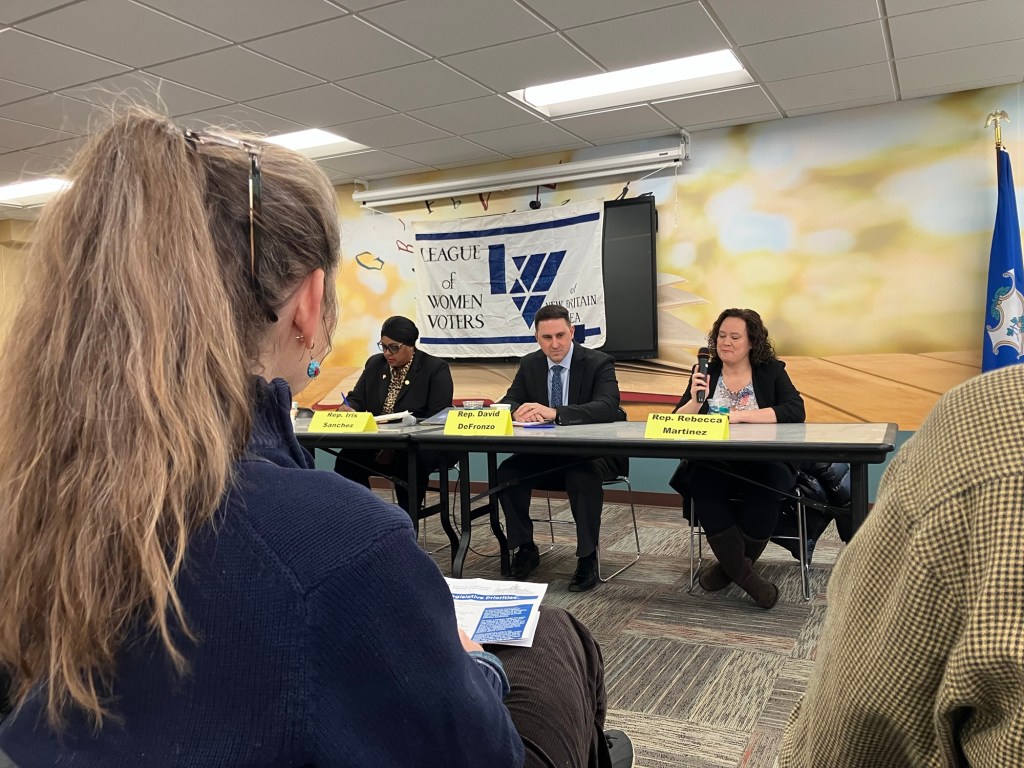
School aid, affordable housing and countering unlawful Immigration and Customs Enforcement (ICE) activity were key topics discussed at a January 31 Legislative Brunch organized by the New Britain area League of Women Voters (LWV).
State Representatives Rebecca Martinez (D-22) of Plainville and Iris Noemi Sanchez (D-25) and David DeFronzo (D-26) of New Britain previewed their work in the 2026 General Assembly session that begins on Wednesday, February 4th.
State Rep. Sanchez, who was sworn in after winning a special election on January 6, succeeds Bobby Sanchez (no relation), who was elected New Britain Mayor. She will serve out this term and seek re-election in this year’s state election to serve a two-year term. Reps. DeFronzo and Martinez were elected in 2024. LWV Secretary Ann Speyer moderated the forum.
The three legislators concurred on several issues raised by the audience and the LWV at the meeting held at the New Britain Public Library’s community room:
- Anticipated that the General Assembly will adjust and extend a $500 million contingency fund enacted in a special session last year that enables Governor Lamont to fill funding gaps for health coverage and the social safety net programs caused by the unconstitutional withdrawal of federal funds for those purposes.
- Favored “no excuse” absentee balloting that, advocates say, will promote higher voter participation to build on the early voting reforms implemented in 2024.
- Supported new protections as the result of ICE detentions that indiscriminately target law abiding immigrants and citizens. Rep. Martinez mentioned a state Senate proposal for a civil rights law that would “allow residents to sue ICE agents or other federal officials if their constitutional rights were violated.”
The Connecticut LWV of which the New Britain chapter is a part is a “nonpartisan, pro-democracy organization” that has joined with other civic and religious organizations to protest “the ongoing ICE detentions, which too often fly in the face of due process and other fundamental rights.”
State Rep. DeFronzo, responding to questions from Aimee Pozorski, Secretary of the New Britain Board of Education, said the New Britain legislative delegation will again seek more state money for New Britain through the Educational Cost Sharing (ECS) formula and excess cost reimbursements that meet the increasing costs of educating children with special needs.
DeFronzo, a teacher and member of the Legislature’s Education and Appropriations committees, acknowledged that the Board of Education is seeking a 14.82 percent increase from city and state sources. The proposed $18,971,610 increase stems mainly from contractual or mandatory costs (88.4%), transportation (12.16%) and special education outplacements (9.53%). DeFronzo noted that New Britain’s local aid from the city’s General Fund has been flat funded for a dozen years. At $17,518,90 in per pupil costs, the city ranks 162nd in local funding for the schools meeting 31 percent of the budget.
While the Governor and General Assembly adopted a two-year, 2026-27 state budget last year, adjustments may be made in the second year. Shifts in funding will be challenging, however, because of substantial cuts in already appropriated federal aid by the Trump administration and Republican Congress. The state Office of Policy and Management (OPM) has set up a federal fund loss reporting site to assess the need to provide state funding.
The legislators indicated new laws and changes will get attention in response to the neglect, abuse and murder of Mimi Torres-Garcia, the 11-year-old child whose remains were discovered in an abandoned house in New Britain last fall.
The public outcry calling for passage of “Mimi’s Law” has been growing. At issue is the evaluation of how the Department of Children & Families handles cases and what is needed to reduce caseloads to protect children. Connecticut is also said to lag behind other states in monitoring home schooling and the welfare of children not attending public or private schools. Legislation calling for monitoring previously failed over the objections of home school proponents. (CT Mirror Story).
The four-month General Assembly session convenes on February 4th and will adjourn on May 6th.
John McNamara is an Alderman from Ward 4 and the Common Council Majority Leader
 NB Politicus