Ordinance Will Allow Reuse of Industrial and Retail Space for Indoor Growing
By John McNamara
Except for backyard gardening and a few greenhouses, raising crops for food and horticulture on a large scale is not an option in densely populated New Britain. But a proposed change to the city’s zoning ordinances would allow underutilized industrial and retails space for “certain agricultural uses.”
“Urban farming is an effective way to promote adaptive reuse of underutilized industrial buildings and shopping centers. Indoor urban farming is similar to a non-nuisance industrial use that would have minimal exterior impacts to a site,” according to the petition that was referred to the Council’s Planning, Zoning and Housing (PZH) for further consideration.
Under the zone change “urban farming” would be a “permitted use” or allowable “special exception” in current zones designated for industrial parks, business uses and a Transit Oriented District on the East Side of the city.
“Certain agricultureal uses” are URBAN FARM, INDOOR: A type of agriculture conducted in an urban setting involved with growing and distribution of plants that are used by people for food, for medicinal purposes, or for aesthetic purposes. May include accessory retail or wholesale sales. Examples include but are not limited to community gardens, rooftop farming, vertical farming, greenhouses and indoor hydroponic or aquaponics systems. For purposes of this definition Urban Farm, Indoor excludes the growing or distribution of cannabis related plants and products.
Urban farm indoor uses involving a minimum of one acre would be granted if they met certain conditions and safeguards:
- Adequate screening shall be provided along all boundary lines adjoining residential
uses and may include fencing and landscaping to effectively screen uses during all
seasons of the year. - Parking and loading areas for the urban farm use shall be oriented to the building
and separate from residential uses. - Outdoor storage shall be prohibited.
Urban farming is not a new idea in New Britain.
ROOTS is the nonprofit organization established in 2013 that has developed youth programs (at every public school), community gardens and a seed library. Its crops are a ready source of healthy food at farmers’ markets. Founded by Joey Listro, now the executive director of the Connecticut Parks and Forest Association, ROOTS sprung from Urban Oaks Organic Farm. The farm, no longer in operation, was developed with the help of grants in 1999 by New Britain’s Tony Norris and Mike Kandefer who marketed their highly regarded herbal crops to restaurants throughout the state. They moved their farming venture from leased land in a rural town and turned unused Sandelli Florist’ greenhouses and open space into a place to grow their crops on Oak Street in the heart of the city. The farm gave residents access to shares in a Community Supported Agriculture (CSA) program.
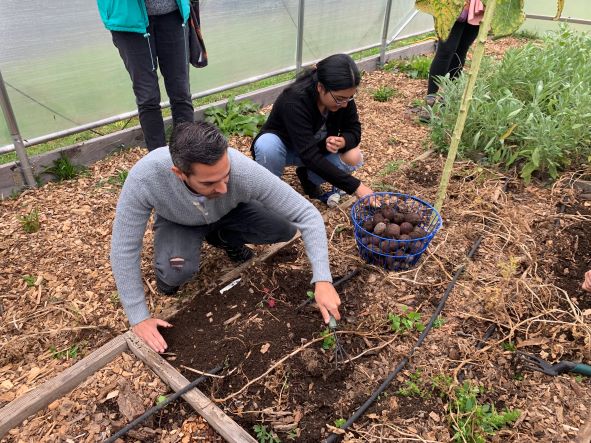
Recently the nonprofit LEVO International has established hydroponic gardens in the Hartford area. LEVO has also teamed up with the Hospital of Central Connecticut and other hospitals to grow fresh fruits and vegetables as a source of good nutrition on hospital grounds. Patients battling diabetes and other ailments are the beneficiaries of the healthy food grown in small spaces.
Vertical farming, hydroponics and community gardens are growing rapidly as a means of planting food and horticulture in cities. Once adopted the New Britain zone change can promote and support more of the work pioneered by ROOTS and LEVO.
It also represents an economic development strategy to make urban farming as a source of small business growth, employment and as a solution to food insecurity especially in cities where “food deserts” have made access to nutritional food limited or nonexistent in many neighborhoods.
John McNamara is a Ward 4 Alderman and the Common Council Majority Leader.

